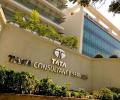
Tata Consultancy Services (TCS) - the largest information technology (IT) services provider in India and the second-largest globally - recently set an ambitious goal of $50 billion in revenue by 2030. The growth required to reach this goal, however, is lower than the company's own standards. In the past decade, TCS revenues, or net sales in US dollar terms, have grown at a compound annual growth rate (CAGR) of 9.5 per cent, from $10.2 in 2011-12, to an expected $25.3 billion during 2021-22 (FY22), based on its revenue trend in the first nine months of FY22.

Size matters on the road. Small is not dominating India's car market any more. The share of cars priced up to Rs 5 lakh in the passenger vehicle market has fallen to 10.5 per cent in the first 11 months of 2021-22, compared with 26 per cent in 2018-19 (FY19), the lowest in four years, according to data from industry sources. Even the share of those in the price range between Rs 5 lakh and Rs 7.5 lakh has dropped to 32.4 per cent in the same period, from 34.9 per cent.

A sharp sell-off in the Indian equities markets after a spike in crude oil prices should not be surprising. Historically there is a negative correlation between stock valuations in India and the price of Brent crude oil, which is the benchmark for the Indian crude oil basket. Between 2011 and 2014, crude oil traded above $100 a barrel for an extended period, the Sensex-trailing price/earnings (P/E) was 18X, on average, during the period, nearly 22 per cent lower than the current index P/E of 23X.

The Tata group flagship has sold more sport utility vehicles (SUVs) in the domestic PV market in the past four months than any other automotive manufacturer, cementing its no.1 spot. It first grabbed pole position in the SUV segment in October 2021 after the launch of the Punch - a sub-compact SUV offering.

The biggest jump in earnings and decline in P/E multiples has occurred with top companies in metals and mining, corporate banking, and the oil and gas sectors.

Emerging markets such as India have always run higher inflation rates than developed economies such as the US and countries of Western Europe. But for the first time in the past 30 years, the US reported a higher consumer price inflation (CPI) rate than India in five consecutive months. The US reported a CPI rate of 7.5 per cent in January 2022 against 6.01 per cent in India and analysts expect the trend to continue for at least a few months more

Encouraged by a steady recovery seen in the first two weeks of February, hospitality firms expect the business hotels in metros including Mumbai, Bengaluru, Chennai, Kolkata and Hyderabad that have been lagging the leisure hotels in terms of revenue per available room (RevPar) to catch up in the coming months. Huge pent-up demand for MICE (meetings, incentives, conference and exhibitions) as companies slowly return to hosting physical events coupled with easing of the recently announced restrictions on international travel, will also help in getting closer to pre-Covid levels of revenue, they said. The Omicron wave that peaked in January had derailed the strong month-on-month recovery seen by the hotels since August.

The biggest headwind to the consumption story in FY23 is a sharp decline in government subsidies on food, fertiliser and fuel, and overall decline in revenue expenditure net of interest payments. This, analysts say, will adversely impact purchasing power of households at the lower end of the income pyramid, translating into lower spending on consumer goods and services.

Ford, which had announced to quit the Indian market last year, said it was exploring the possibility of using one of its plants in India to produce electric cars for exports.

Owing to a big rise in the market capitalisation of group companies such as Adani Green Energy and Adani Transmission, the group promoters, the Gautam Adani family, have closed the wealth gap with Mukesh Ambani, the promoter and owner of Reliance Industries Ltd (RIL). Ambani continues to top India's billionaire league table. The Ambani family's net worth was estimated to be Rs 8.06 trillion (around $108 billion) on Tuesday against the Rs 6.87 trillion (around $92 billion) of the Adani family.

After a very weak December quarter and a poor year-to-date fiscal year volumes-when sales plunged to the lowest in nine years, the signs in the first 15 days of January haven't been encouraging either. "Though the severity of the current wave is not as high as the previous one, it has hit the sentiments hard impacting conversion of enquiries into sales," said Vinkesh Gulati, president, Federation of Automobile Dealers Association (FADA).

The group began to outperform the broader market only with the onset of the pandemic in March 2020 while earlier it was largely keeping pace with the Sensex. The group's market cap is up 164.4 per cent since the end of March 2020 against a 105 per cent rally in the Sensex.

In a bad start to the new year, hotels are counting their losses again. Weddings and corporate events for this month have either been called off or postponed. The blow has throttled the nascent recovery which had kicked in around August. It is primarily hurting the banquet-driven hotel chains, some of which are seeing cancellations running into lakhs for a single day.

The Tata group companies are now more valuable than all the listed central public sector undertakings (CPSUs) or companies in the country. The key 20 listed Tata companies ended the 2021 calendar year with a combined market capitalisation of Rs 23.36 trillion, ahead of the 70 listed CPSUs, which had a combined m-cap of Rs 23.2 trillion. In comparison, these CPSUs had a combined market capitalisation of Rs 16.7 trillion at the end of December 2020 against the Tata group firms' combined m-cap of Rs 15.7 trillion.

On the itinerary: Luxury camping, tribal homestays, heritage cities.

'Some of the launches may get deferred due to the semiconductor shortage, which is unlikely to get resolved before the second half of 2022.'

Passenger Vehicle makers are likely to see their cumulative earnings at an operating level erode by Rs 1,800-2,000 crore in the year ending March 2022 on account of the shortage of semiconductors, rating agency Icra said at a webinar on Wednesday. The industry, it pointed out, is estimated to lose production of 500,000 units at the end of FY22 due to the chronovc shortage the chip, which is critical in safety, entertainment and the various other smart features of a car. "In absence of the chip crisis, the industry volumes are likely to have exceeded the all-time peak annual volumes." Icra has pared its growth estimates for the PV market from the earlier 10-14 per cent to 8-11 per cent now in FY22.

India's electric mobility goal, which has so far been riding on two wheels, is all set to graduate to four wheels. At least, the journey has begun. Hyundai Motor India said it would invest Rs 4,000 crore till 2028 to launch half-a-dozen electric vehicles (EVs) in India. It would eventually straddle premium and mass segments. The first of these - the electrified version of an internal combustion engine (ICE)-powered model - will go on sale as early as next year.

'We are not organising any large celebrations on New Year's Eve to avoid last-minute changes in guidelines.'

'Bharat has been leading, but it cannot carry India as the bulk of the sales come from India in terms of volume and profitability.'
 © 2026 Rediff.com - Advertise with us - Disclaimer - Privacy Policy - Sitemap - Feedback - About us - Terms of use - Grievances